Prologue: Before You Cross
Every legend begins as someone's bedtime story.
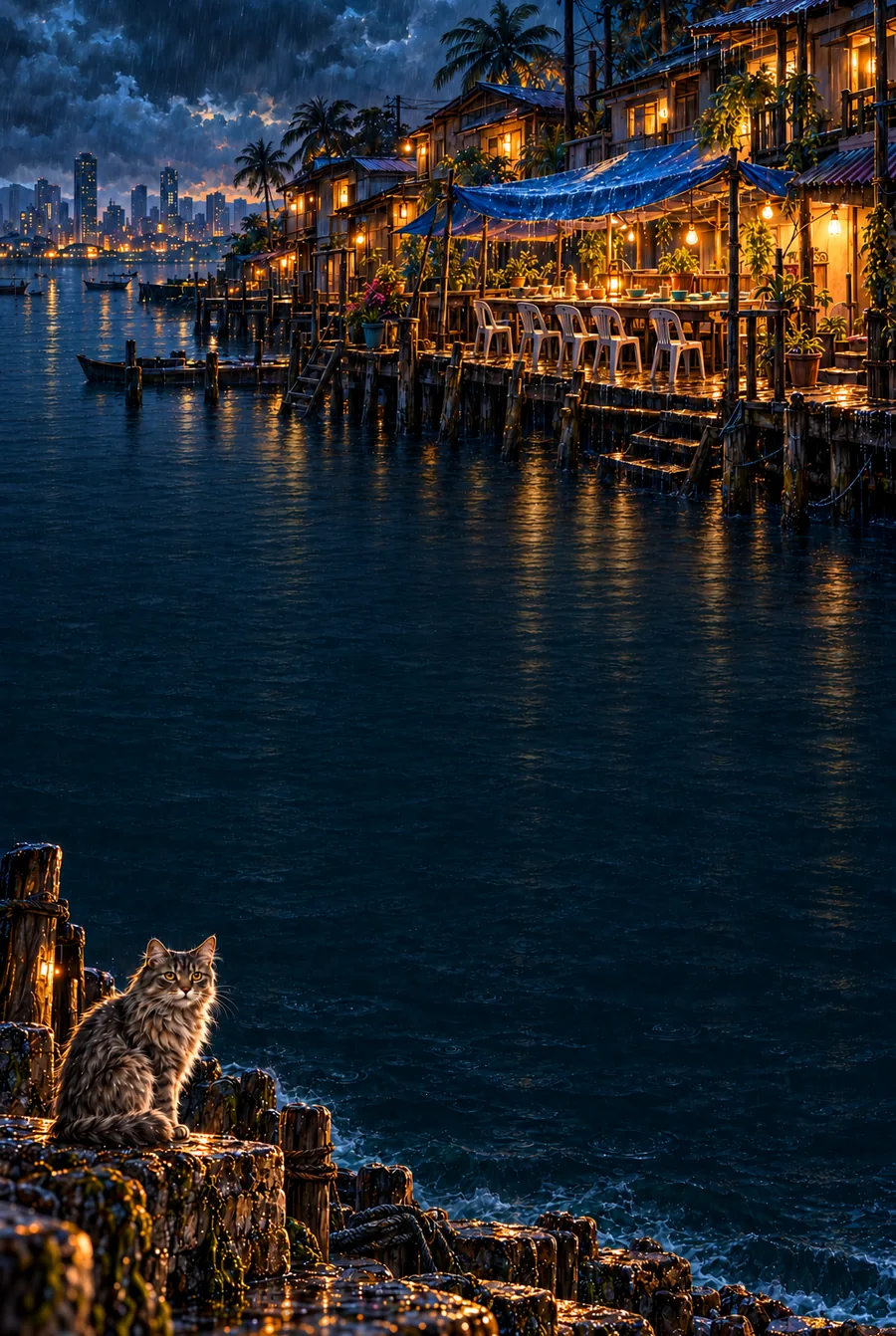
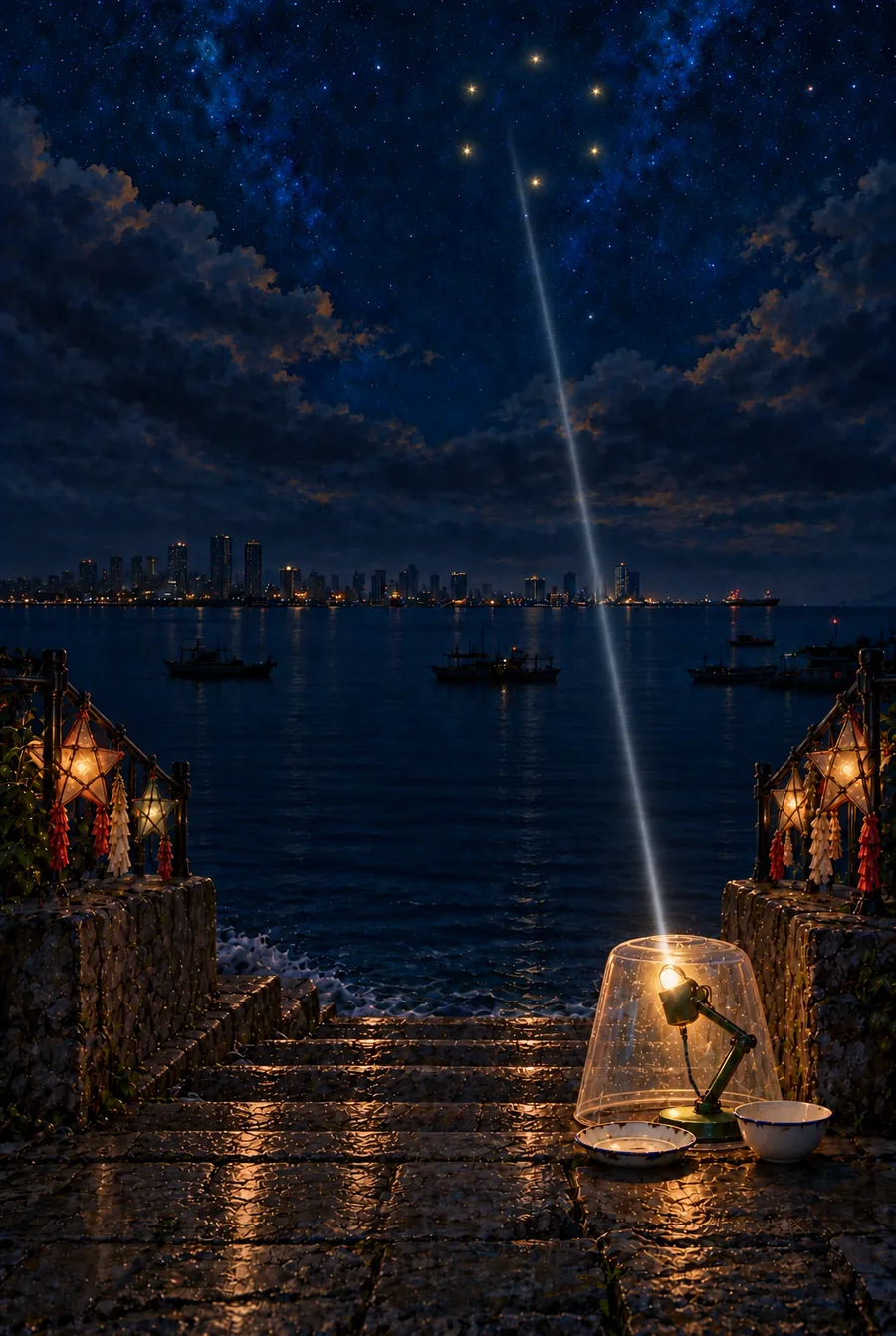
This one began on a stair. Fifteen old stones going down into Manila Bay from the end of a narrow street in Malate, behind a repair shop with a hand-painted sign and a grey cat on the sill. Most people who walk along that seawall never notice the stair. The ones who do assume it is part of the old breakwater, or a fishermen's landing nobody uses anymore, and walk on.
The keepers of Calle Mabini have stood at the top of it for nine generations, and their line for thirty. They have never walked on.
This book is a companion to the five volumes of the Chronicles of the Caramoan: The Drowned Stair, The Serpent's Welcome, The Dimming, The Last Moon and The Twin Kings. It is not a sixth story. It is a map, a lexicon, a register of names, a little shelf of old texts, and a guide for anybody who has come up the stair from the last page of Book Five and wants to sit on the top step for a while before going home.
It can be read before the series, alongside it, or after. It was written to be read in any order. Open it anywhere. The saucers stay filled.
Chapter 2: The Seven Moons
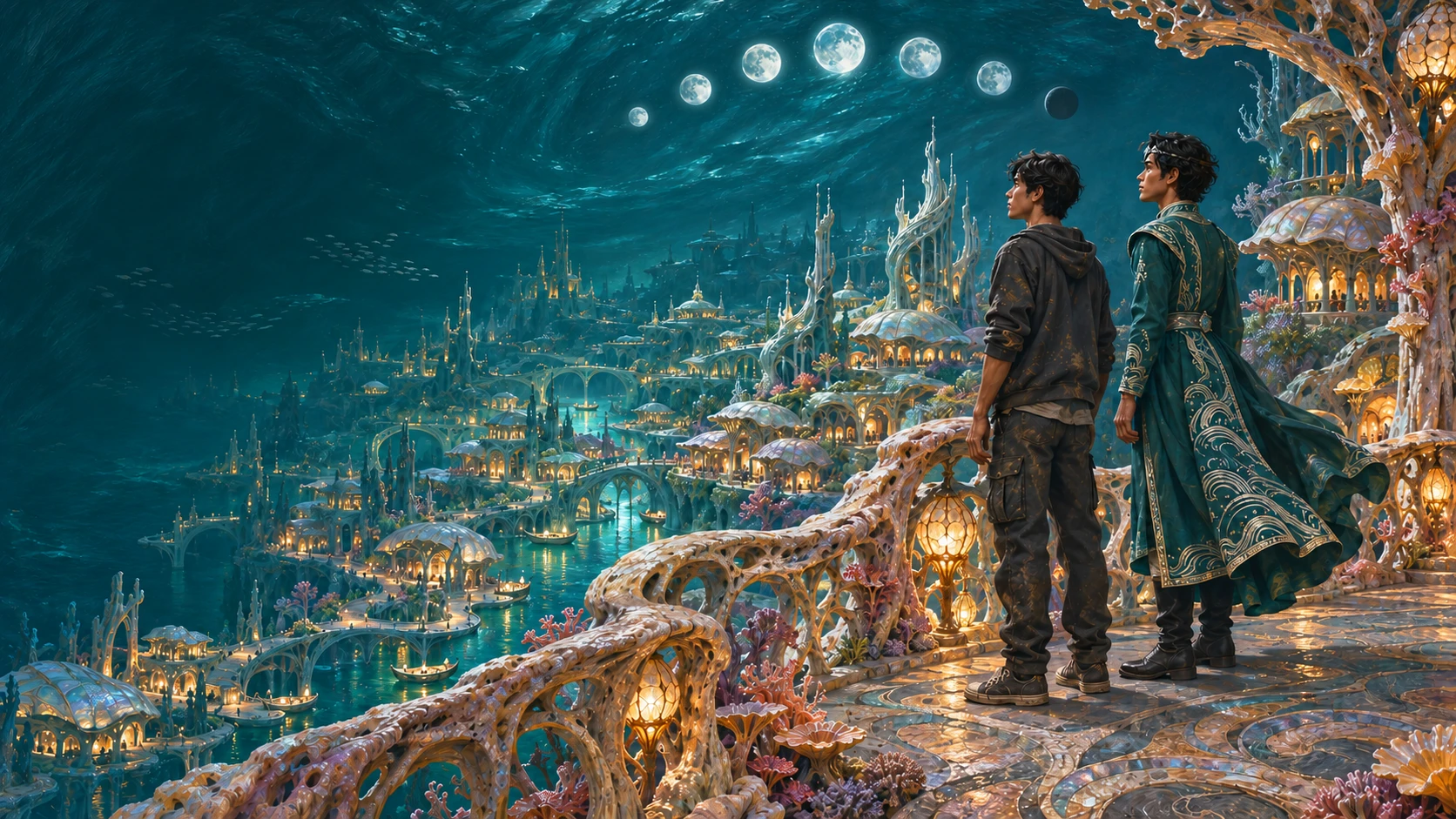
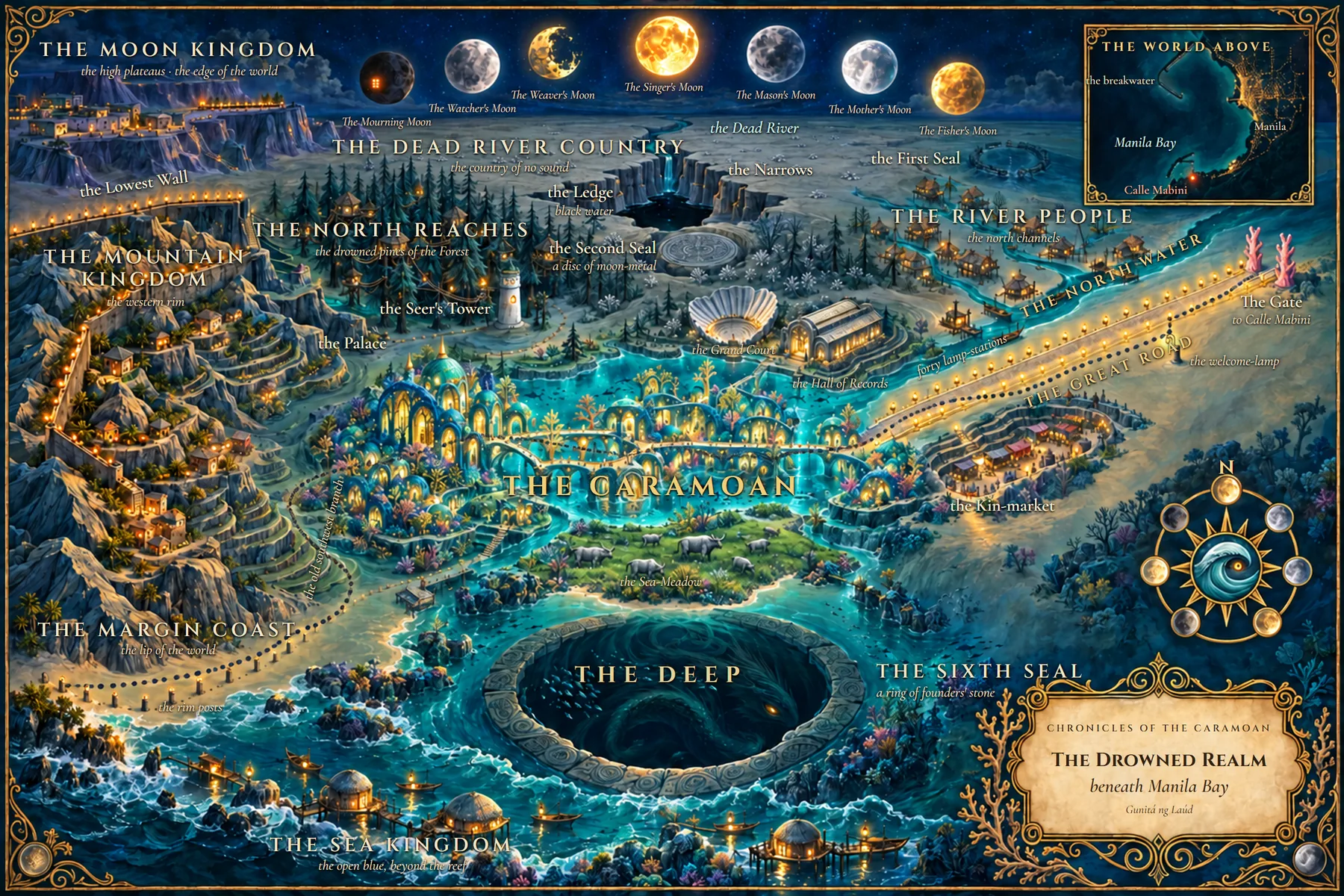
Over the drowned realm of the Caramoan there is no sun. There never has been. The realm lies under the sea, below Manila Bay and a great deal of the world besides, and the light that falls on its terraces and roads and shell-roofed houses comes from two places only: from lamps that its people light, and from seven moons that hang in an arc across its sky.
The moons are the realm's calendar, its clock, its oath and its oldest story. A child of the Caramoan swears pitu-bulan! — "seven moons!" — the way a child of Manila says Diyos ko. The realm has never in ten thousand years said six.
The seven
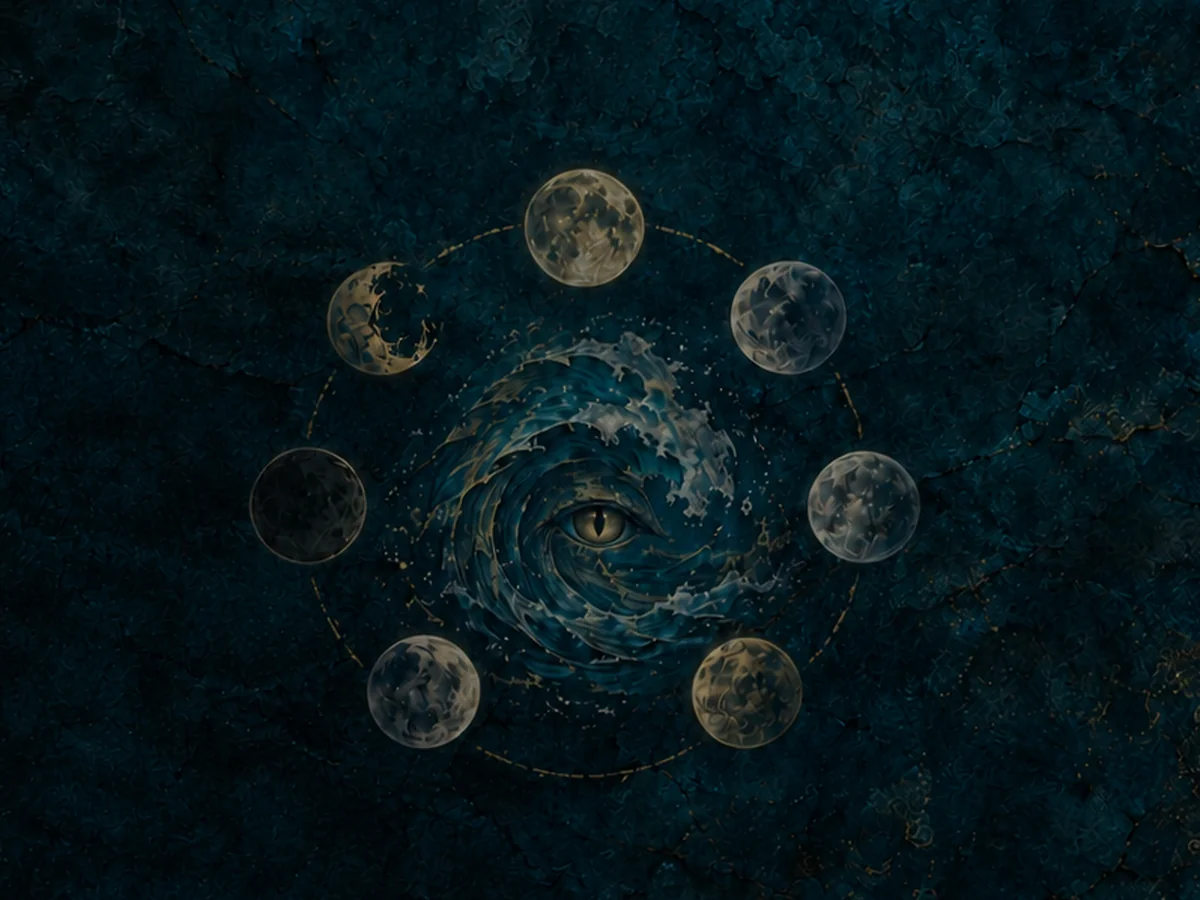
The moons are named in order across the arc, from the eastern rim to the western. Each has a House or an office associated with it, a feast, and a scroll of prophecy.
The Fisher's Moon — the first. Gold. Under it the women of the Net take their seals out to the reef. It is the moon of provision.
The Mother's Moon — the second. Silver-white, the softest light of the seven. Under it the realm's infants are carried to the Joining pool on their third day. It is the moon of the cradle.
The Mason's Moon — the third. Stone-grey, like cut stone. Under it the Mountain's builders and the realm's road-crews do their great work. It is the moon of foundations.
The Singer's Moon — the fourth. High gold, the brightest. The cantors' moon, under which the realm sings its oldest songs at the Feast of Tides. It is the moon of the Song.
The Weaver's Moon — the fifth. Soft gold, like old cloth. The moon of law and binding, of the codex and the courts. The fifth of the Seven Moon Scrolls, which holds the Passage of the Two, belongs to it.
The Watcher's Moon — the sixth. Steady silver. The moon of the Watch and the rim posts and of anyone who sits up at night so that somebody else can sleep.
The Mourning Moon — the seventh. The last in the arc. Dark-faced as long as anyone can remember, with something at its heart that the shadow-plays show as a small lit window. Every Feast the realm tells its children a pretty story about it, with a greedy fish in it, and promises them it will one day forgive and be lit again. The realm has never been there.
The moon-eater
Most peoples of the Philippines know the Bakunawa, by that name or another (the Tagalogs have Laho): the great sea-serpent that rises out of the deep and swallows the moon, so that the people must come out with pots and drums and shout to make it give the moon back. In the realm of the Caramoan the same story is told on Feast-eve with shadow-puppets on a sail, to roaring children, and has been for longer than anyone can count. A great coiled shape rises behind the sail; a moon is cut from paper; the children scream; the cantors bang the pots.
In the realm, the story has a second half that Manila does not tell. The founders of the Caramoan, ten thousand years ago, are said to have bound the moon-eater under seven seals, sung beneath seven moons, and the realm has lived on top of it ever since. Every child of the realm grows up knowing that something is down there, below the floor of the sea, asleep, chained, singing to itself in the dark.
The Chronicles begin with that singing.
Reading the moons in the novels
Readers will find the moons doing a great deal of work in the Chronicles, and it helps to know a few things in advance.
When a moon is described as dimming, something in the realm forgets. A moon is a remembering, hung in the sky.
The moons have shadows on the water. Each moon lays a silver road on the sea of the realm, and the realm's people use them for navigation the way Manila's fishermen use lighthouses.
The Seven Moon Scrolls
Each moon has a scroll of prophecy, kept in the Seer's tower, copied by the cantors, and read aloud at the moon's feast. Together they are the Seven Moon Scrolls, the third of the realm's sacred texts. They are not wholly true. Like all prophecy in the Chronicles, they are participants: the Seer of the Caramoan warns the Grand Court in Book Two that a prophecy read aloud is not a weather report; it changes the people who hear it.
The most important passage is in the fifth scroll, the Weaver's. It is called the Passage of the Two, and Isagani himself reads it aloud before the Grand Court in Book Two. Here it is, whole, as he read it:
When the water gives two where it owed but one —
twin seeds of a single dive,
born beneath the mourning lamp —
mark that tide, for the turning is come.
One shall be taken and one shall be kept,
and the kept shall grieve the taking,
and the grief shall be a door.
And when the two stand palm to palm
where the old road meets the water,
the age of the wall is ended:
one shall save the people,
and one shall break what the grandmothers built,
and the deep shall have its answer at last,
and the Sea will remember its First.
The criers of the realm compress it, the way criers do, into four words that become a slogan, a quarrel, a children's game and nearly a civil war: One saves. One destroys.
Readers who have finished the series will know how much depends on the word what.
Chapter 4: Calle Mabini
Calle Mabini is a short, narrow, ordinary street in Malate, Manila, that runs down to the old seawall and stops. It has a repair shop, a sari-sari store, a vulcanizing shop, a bakery on the corner, a great many cats, a barangay that does not fix the street lamps, and, at the very end, behind a gap in the seawall that most people walk past, a stone stair going down into the bay.
It is the best place in two worlds.
The shop
Cruz Repairs — Radio · TV · Electric Fan, says the hand-lettered sign across the front window, painted by Hiraya Cruz's mother and touched up by Hiraya every second Christmas. It fixes what is handed to it. It always has. Labor is free if the customer worked.
The bench runs along the side wall. It is the heart of the Chronicles, as much as the Grand Court or the stair, and readers will want to know its geography:
The tool end is by the pegboard, where the screwdrivers hang in order of size and the pliers in order of temper. It is Buboy's.
The light end is under the good lamp, the anglepoise with the sixty-watt bulb. The light end can see the whole bench. It is Isagani's.
The middle is Liwliwa's, one Saturday a month, on a stool that was added one summer and never remarked upon.
The dark end is by the back door, under a shelf of dead radios and a 1996 calendar with a picture of Mount Mayon on it, where the lamp does not reach and you learn to work by feel.
The shelf above the bench holds, from left to right: a radio that only plays static and has never been tuned to anything or broken; a small brass bracket, screwed to the shelf's edge because something the size of a maya needed a grip; and a jar of screws.
The sill of the front window is wide old narra, worn pale in the middle. It is the post of the shop's foreman, a grey cat named Abo.
The front room behind the shop has a banig — a woven sleeping mat — rolled out on Saturday nights for whoever needs it.
The kitchen is where everything important is decided, at two in the morning, over salabat with too much sugar.
The street
Aling Nena's is four houses down, at the seawall end. Aling Nena is seventy-four when the last books begin and has a stick since the summer. Her house was the first window — the first one on Calle Mabini to put a light in it for the keeper, in Book One — and on a typhoon night, when the warning goes to Signal Number Three, the whole street goes to Aling Nena's, because that is what Signal Three means on Calle Mabini.
The sari-sari store, Aling Precy's, sells a little of everything: rice by the cup, single cigarettes, shampoo in sachets, Coke, salt for the keeper, and once, a chalkboard square on which somebody wrote a name. A wall clock hung over its counter, stopped at twenty past four, from 1987 until somebody fixed it.
The vulcanizing shop, Kuya Boyet's, fixes tires and lends out its tools, its brackets and once a bulb.
Mang Pepe's bakery on the corner sells pandesal warm every morning and gives the day-olds to Aling Nena.
Mang Celso the taho man comes up the street at six every morning with two cans on a bamboo pole — warm silken tofu in one, brown syrup and sago pearls in the other — and calls taho at the corner, and has not once in forty years been late.
The long table is the barangay's folding one, which comes out of the barangay hall for fiestas and for anything else the street decides is a fiesta. It is set down the middle of Calle Mabini under a blue tarpaulin and strung with fiesta lights that blink in a pattern Aling Nena says has been the same since 1978. Every house brings its chairs. Every house brings a dish. Readers of the last two books will sit at it many times.
The seawall runs along the end of the street and on toward the boulevard. Along it, at Christmas, Calle Mabini hangs its parols — star lanterns of bamboo and capiz shell — facing out over the bay. A concrete bench stands farther along, with the faded name of a funeral parlor painted on its back.
The stair
Fifteen steps of old stone go down from the gap in the seawall into Manila Bay.
The top step is where the keeper stands at night.
The third step is where the weight is. Readers of Book Five will learn what that means.
The sixth step is the keeper's step. The keeper goes down to it at a quarter past five in the morning, into the water to her knees, and puts her hand flat on the old stone of the wall on the left-hand side — the keeper's side — and reads.
The fifteenth step is the last one above the old road. Below it the stair keeps going, and becomes the road, and the road goes down to the gate.
Beyond the street
The estero is Manila's network of old tidal creeks and canals. The mission of Holy Innocents stands on the lip of one, in Paco, where the property line meets the water at a cement corner. Santi grew up there.
Paco is the old district where Holy Innocents stood before 1936, when it moved three streets to the estero. There is a round cemetery there with the dead in its walls, a church called San Fernando de Dilao, and a public school with an acacia in its yard.
Bahay Liwanag — the House of Light — is a children's home far down the coast road to the southwest, on the margin coast, run by Sister Pilar. It has forty-four beds and a lawn that runs down to a seawall.
A note on Manila in the Chronicles
The Manila of the Chronicles is real and imaginary at the same time. Malate is real, and Paco and Tondo and Pasay and Taft Avenue and the Malate church and Roxas Boulevard. Mabini Street is real too: A. Mabini Street runs through Malate and Ermita. But the Calle Mabini of these books, with its repair shop and its stair, is the story's own; the books borrow a real street's name the way the old stories borrow a real mountain's, and readers who go looking for the gap in the seawall will not find it.
They may find something like it. Most old Manila streets that run down to the water have a cat on a sill at the end of them, facing the bay.
Chapter 9: The Rememberers
Children in both worlds call them cats.
The oldest people smile and know better.
When the First Song was sung, the grandmothers say, every creature heard it. Only one kind remembered every note — not because they were wiser than the rest, but because they listened. They are among the oldest beings to know both worlds, and they walk between them without ceremony. In the realm they are called the Laála, the Rememberers. In Manila they are called pusa, and fed at the back step, and nobody thinks about them much, which suits them.
They are never owned. They are never summoned. They are never explained. They arrive, look at a person, and decide.
Their greeting — the thing a Rememberer says, without saying it, when it has chosen to sit beside you — is the oldest greeting in the world:
There you are.
What the Rememberers do
They watch thresholds. The cats of Calle Mabini stare at the stair. Aling Nena's cat will not cross the street on certain tides. A child in Manila says my cat keeps staring at an empty corner, and the adults laugh, and the reader of the Chronicles knows the corner is not empty.
They keep vigils. A Rememberer will sit on a sill, or a wall, or a step, for years, facing something, and not leave.
They escort. A Rememberer will walk a frightened person home, at a distance, without being asked, and then go back to its post as if nothing had happened.
They are never sold. The great Kin-market of the Caramoan sells every kind of creature but one. Ask an Enkantan why there are no cats for sale, the Chronicles advise, and watch them change the subject.
The Houses of the Rememberers
The Rememberers have Houses, as the Caramoan do. They are not breeds. They are lineages of temperament — ways of remembering.
The House of the Tide remember where people belong. They always find the way home.
The House of the Moon remember dreams. They sleep beside children marked for great things.
The House of the Ember remember grief. They keep vigil over mourners at the nearest honest boundary — a step, a sill, a property line — and they never cross it, because grief must not be crowded, and they never leave, because grief must not be alone. The Queen of the Caramoan says of them, in Book Two: The Ember House does not only attend mourning that has arrived. Sometimes they are early.
The House of the Wind are curious and restless, and find forgotten paths.
The House of the Lantern are the rarest. They accompany those who build bridges between worlds.
Death and the Rememberers
When a person dies, their Rememberer does not. It returns to the Sea, still remembering, and waits. This is not reincarnation, the grandmothers are careful to say. It is memory continuing. The same vocation; never the same bond.
Sayings about the Rememberers
The old women of both worlds have sayings about them, and the Chronicles collect a few.
If a cat chooses to sleep beside you, no wandering shadow may cross your threshold.
May your Rememberer always find you. — a blessing over newborns.
Do not fear the road. If one of the old cats walks beside you, you have never truly lost your way. — a grandmother's farewell.
If a cat sits on your step, it's because somebody is remembering you. — the children of Bahay Liwanag, delivered as breaking news.
Nagtitipon ang mga alaala. — The rememberings are gathering. Said by the old women of the flooded districts when the cats of a street leave their posts together.
Abo
The most important Rememberer in the Chronicles is a grey cat named Abo — ash; the color of a fire that is done arguing.
He walked into the repair shop on Calle Mabini on the worst night of a bad season, the year the condemned baby arrived, a wet grey stray, and the keeper by every account including her own wanted absolutely nothing to do with him. We don't feed what we can't afford. There was a hundred-day standoff. He won.
He is the foreman of Calle Mabini. He keeps the shop's sill. He was watching the odd black bead on the keeper's rosary years before anybody else knew what it was. He follows no one and is surprised by nothing. In Book Two he leaves the sill, for the first time in the recorded history of the arrangement, to walk a frightened boy home. He is of the Ember House.
He greets everything as if it had been expected, and was late.
The Lantern
The other great Rememberer of the series is an old brass-eyed cat of the House of the Lantern, who lives somewhere along the dark road and turns up at the edges of the Chronicles from Book Three on. Readers will meet her looking at a girl for two seconds at the foot of a road; walking on the water in Book Four; and, in Book Five, leaning against a boy's leg in a very dark place.
The children who knew her best called her Muning.
The rest is in the book
The companion goes on: Calle Mabini, the doors and their keepers, the seven peoples and the Houses, the Kin and the Rememberers, the old tongue, a shelf of old texts, the cast of both worlds, and questions for the long table. Every spoiler in it is marked, so it can be read at any point.
The books are coming out as e-books from 1 December 2026.
Order from the author